
Building a new home is one of the biggest investments most Australians will make. From the initial foundation works to the final handover, every construction stage plays an important role in the safety, durability and overall quality of the finished building.
However, construction defects can occur at any stage, even when experienced builders and tradespeople are involved.
At Ausgun Building Inspections, we provide independent construction stage inspections across Melbourne and regional Victoria, helping homeowners identify visible construction defects before they become concealed by subsequent building works.
In this article, we explain the different construction inspection stages, common defects and why independent inspections are worth considering when building a new home.
1. What Is a Construction Stage Inspection?
A construction stage inspection is an independent assessment of building work at a particular stage of construction.
The purpose is to identify visible workmanship defects, potential non-compliance and other construction concerns before the project progresses.
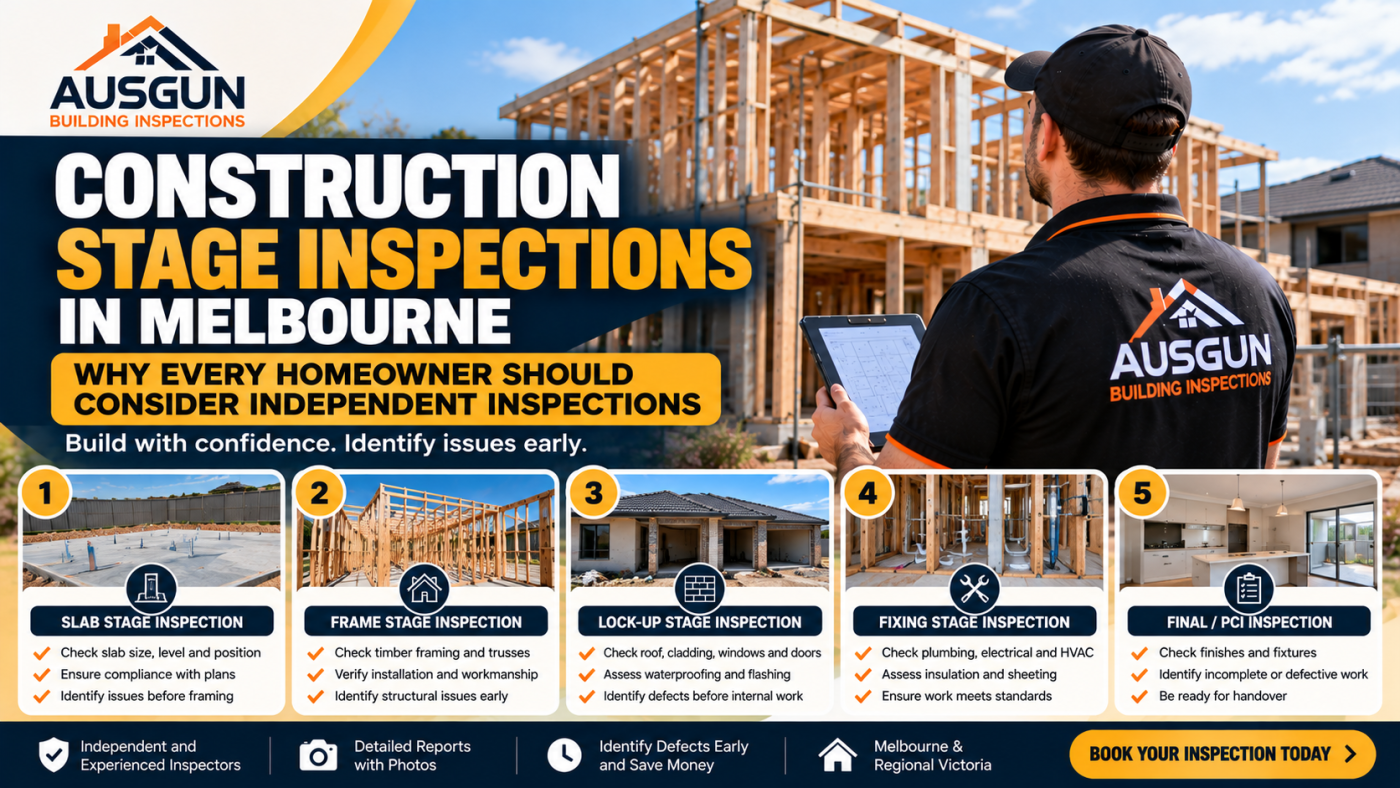
Independent inspections can be arranged at stages such as:
- Slab or foundation stage
- Frame stage
- Lock-up stage
- Fixing stage
- Final or Practical Completion Inspection (PCI)
These inspections are separate from the mandatory inspections carried out by the appointed Relevant Building Surveyor (RBS).
An independent building inspector does not replace the building surveyor or provide statutory approval for construction work to proceed.
2. Slab Stage Inspection
The slab or foundation stage is one of the most important stages of construction because it provides support for the building.
An inspection may assess visible aspects of the work, including:
- Foundation preparation
- Slab dimensions and layout
- Reinforcement placement, where visible
- Vapour barriers
- Plumbing penetrations
- Set-downs and slab edges
- Visible workmanship concerns
A pre-pour inspection is generally more useful for assessing reinforcement and other components that will be concealed by concrete.
Once concrete has been poured, these elements are no longer directly visible.
Common defects: Incorrectly positioned reinforcement, damaged vapour barriers, inadequate reinforcement cover or slab dimensions that differ from the approved plans.
3. Frame Stage Inspection
The frame stage inspection is particularly important because the structural framing remains visible before plasterboard and other finishes are installed.
During this stage, an inspector may assess:
- Timber wall framing
- Roof trusses
- Floor joists and bearers
- Structural beams and lintels
- Bracing elements
- Tie-down connections
- Framing alignment
- Visible installation defects
Common defects include:
- Damaged timber studs
- Incorrectly installed framing members
- Missing or inadequate connections
- Poorly installed bracing
- Damaged roof trusses
- Incomplete tie-down details
- Excessive gaps or poor workmanship
Recommendation: Identified structural concerns should be referred to the builder and, where necessary, the project engineer for assessment and rectification.
4. Lock-Up Stage Inspection
The lock-up stage generally occurs when the external building envelope has substantially progressed, including roofing, external walls, doors and windows.
An independent inspection may assess:
- Roof coverings
- Roof flashing
- External brickwork
- Wall cladding
- Window installation
- External door installation
- Weatherproofing details
- Gutters and downpipes
Common defects include:
- Gaps around windows
- Poorly installed flashing
- Incomplete external cladding
- Damaged roof tiles
- Defective brickwork
- Inadequate sealing around openings
- Water penetration risks
Recommendation: Weatherproofing defects should be addressed before they lead to moisture damage within the building.
5. Fixing Stage Inspection
The fixing stage involves the installation of many internal building components and finishes.
Depending on the construction program, the inspector may assess:
- Internal doors
- Skirting boards and architraves
- Cabinetry
- Plasterboard finishes
- Wet area finishes
- Visible plumbing fixtures
- Internal fittings
- General workmanship
Common defects include:
- Poorly fitted doors
- Gaps in skirting boards
- Damaged plasterboard
- Incomplete cabinetry
- Poorly finished joints
- Defective tile installation
- Missing or loose fixtures
An inspection at this stage can help identify issues before final painting and handover.
6. Final Stage and Practical Completion Inspection
The final inspection, also known as a Practical Completion Inspection or PCI, is generally carried out when construction is approaching completion.
The purpose is to identify visible defects, incomplete works and workmanship concerns before handover.
Common findings include:
- Poor painting finishes
- Cracks in plasterboard
- Doors rubbing against frames
- Damaged tiles
- Missing fixtures
- Defective silicone joints
- Roof flashing gaps
- Incomplete ventilation ducting
- Poorly installed cabinetry
- Water ponding in gutters
The inspector documents observed defects and provides recommendations for further assessment or rectification where appropriate.
7. Why Are Independent Construction Inspections Important?
Independent inspections provide an additional assessment of the construction work from the homeowner’s perspective.
Identify defects before they are concealed
Some construction defects become difficult to identify once plasterboard, cladding or other finishes are installed.
Reduce the risk of expensive repairs
Identifying issues early may allow the builder to rectify them before additional construction work takes place.
Improve communication with the builder
A written inspection report can help homeowners clearly communicate observed defects and concerns.
Support quality workmanship
Independent inspections can encourage closer attention to construction quality and finishing details.
Provide documentation
Inspection reports and photographs provide a record of visible conditions at the time of inspection.
8. Are Construction Stage Inspections Mandatory in Victoria?
Victoria requires certain mandatory building inspections during construction.
These are carried out under the building permit process by the appointed Relevant Building Surveyor or an authorised person.
However, independent construction stage inspections arranged by homeowners are generally optional.
They provide additional quality assurance but do not replace statutory inspections, building permits or occupancy approvals.
Homeowners should check their building contract and arrange access with the builder before booking an independent inspection.
9. When Should You Book Each Inspection?
Timing is important because construction work progresses quickly.
Slab stage: Before concrete is poured, where the inspection is intended to assess reinforcement and other concealed components.
Frame stage: After structural framing is completed and before it becomes concealed.
Lock-up stage: When external walls, roofing, windows and doors are substantially installed.
Fixing stage: When internal fittings and finishes have progressed sufficiently for inspection.
Final/PCI stage: When the builder advises that the property is approaching practical completion.
It is important to coordinate inspection dates with the builder to avoid missing key stages.
10. What Happens If Defects Are Found?
If an independent inspection identifies construction defects, the homeowner can provide the report to the builder.
The builder should assess the findings and arrange appropriate rectification where required under the contract and applicable building requirements.
For significant structural concerns, an engineer or other specialist may need to provide further advice.
Homeowners should avoid making unauthorised changes to construction work and should follow the relevant contractual procedures for raising defects.
11. How Much Do Construction Stage Inspections Cost in Melbourne?
Inspection costs depend on the construction stage, property size, location and complexity of the building.
Some homeowners book individual inspections, while others arrange multiple inspections throughout construction.
For example, a homeowner may choose to inspect the frame stage, lock-up stage and final stage.
For an accurate quotation, contact Ausgun Building Inspections with the property address, building plans and expected construction schedule.
12. Can Construction Stage Inspections Prevent Future Problems?
Independent inspections cannot guarantee that a building will be free from defects.
However, they can help identify visible issues at stages when rectification may be more practical.
For example, a framing defect identified before plasterboard installation may be easier to assess and repair than the same defect discovered after completion.
Similarly, defective flashing identified during lock-up may be repaired before internal moisture damage occurs.
Early identification can help reduce the likelihood of more complicated repairs later.
Why Choose Ausgun Building Inspections?
Ausgun Building Inspections provides professional construction stage inspections across Melbourne and regional Victoria.
Our team assesses visible construction work and provides reports identifying observed defects and areas requiring attention.
Our services include:
- Slab Stage Inspections
- Frame Stage Inspections
- Lock-Up Stage Inspections
- Fixing Stage Inspections
- Final and PCI Inspections
- Pre-Purchase Building Inspections
- Combined Building and Pest Inspections
- Section 137B Owner Builder Reports
Our aim is to help homeowners understand the progress and visible condition of their construction project.
Book Your Construction Stage Inspection in Melbourne
Are you building a new home in Melbourne or regional Victoria?
Arrange independent construction stage inspections to help identify visible defects before the next stage of building work begins.
Whether your home is at frame stage, lock-up stage or approaching final handover, Ausgun Building Inspections can assist.
Build With Confidence. Inspect Every Important Stage.
Contact Ausgun Building Inspections today to arrange your inspection.
Website: https://ausgunbuildinginspections.com.au/
Your Property, Our Priority.